



In this tradition, self-care is supported by being able to give yourself Reiki regularly, and many practitioners find a daily rhythm helpful. Reiki is understood to work with the body, mind, emotions and spirit as a whole, and practitioners describe a growing sense of harmony and balance with practice. What follows is about building a gentle self-treatment routine — as often as suits you, not as an obligation.
The Importance Of Daily Self-Treatment
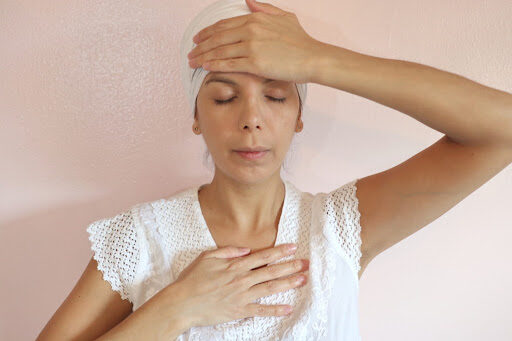
Your Reiki Master may also offer you additional hand positions attuned to your own needs during your first Reiki 1 class, which you can use to give yourself a self-treatment. Many practitioners spend three to five minutes at each position, so a full treatment may take somewhere between thirty-six minutes and an hour. When time is short, you can spend one or two minutes at each position, or simply practise for as long as is comfortable. There is no minimum amount required; you can return to a longer treatment another day if you wish.
When it comes to timing, there are CDs and tapes specifically designed for use during Reiki sessions, so those can be beneficial. My preferred method of counting the seconds is to keep my eyes closed so I can't see the clock's ticking, even though it helps me keep track of the time.
Your ability to let the energy influence how long you spend in each hand position and where you place your hands will improve with experience. Even yet, if you're always hurrying your self-care and giving yourself less time, you might want to pause and consider why this is the case. Why don't you take a few minutes out of your day to relax and recharge? Don't you think it's about time? Alternatively, are you moving at a rate that is too fast for you? Are you hurrying around after everyone else and neglecting your own needs in the process? Self-love and self-care are not mutually exclusive, and self-care is not selfish. This makes sense. It doesn't matter how much love you receive from others if you feel loved and appreciated by yourself.
Even though self-treatments can be done at any time of day or night, lying down or sitting in a comfortable chair is preferable because your body and arms are adequately supported. Many people find just after getting out of bed a natural time. However, set your alarm clock to go off again approximately 40 minutes later if you fall back asleep.
Many people find it a restful way to wind down for the night; if you are exhausted, you may only reach the fourth or fifth hand position before falling asleep, and that is perfectly fine. If sleep problems are persistent or distressing, speak to a qualified professional. A Reiki self-treatment may feel calming, but it is not a medical treatment.
It's pretty okay if you don't always conduct your self-treatment at the same time each day; it should be something you like doing for yourself, not something you feel obligated to do. You could try it after the kids have gone to school or during your lunch break; if you commute by bus or train, you could even try it while sitting on the bus or train.
Many of my students say they feel little or nothing in their hands when they self-treat, and I have noticed the same thing since I began self-treating in 1991. That is not a sign that anything is wrong. Sensation varies from person to person and from day to day: some people notice warmth or tingling, others mainly a sense of quiet and relaxation, and some notice nothing in particular. None of this is a measure of whether the practice is "working."
If your hands become hot, cool or tingly while you rest them on a particular area, you can simply keep them still for as long as it feels comfortable. There is no rule that says you must wait for a sensation to pass, and a strong sensation does not mean you need "more" Reiki — it is just an experience. Move on, or stop, whenever you wish. The hand positions do not have to be timed to the second.
Conclusion
In the tradition, regular self-treatment is described as clearing "blockages" and supporting wellbeing on every level, and many practitioners say the practice deepens with use. What you may notice most is simply that it becomes a pleasant, contemplative part of your day — something you look forward to rather than an obligation. There is no promised health outcome here, and no set amount is medically required; choose the rhythm that fits your life, and continue any care your doctor has advised.
A shorter version for busy days
A full sequence is not the only valid practice. On a crowded day, try this ten-minute version:
- Sit or lie down and take three easy breaths.
- Rest your hands on your chest for two minutes.
- Move them to your abdomen for two minutes.
- Rest them on your thighs or knees for two minutes.
- Finish with your hands in your lap and one sentence of intention.
You can also choose a single position that feels comfortable and stay there for five minutes. The practice is not a course to complete; a short pause done with attention is still the practice.
Making it a habit
Habit is easier when the practice is attached to something you already do. Some people treat it as the first thing after waking, others as a transition after work, and others as a way to settle before sleep. Pick one cue and keep the first version short enough that you will actually do it.
If you miss a day, simply begin again. There is no accumulated debt and no need to double the next session. A rigid rule that makes you feel guilty is less useful than a flexible routine you can return to.
Questions people ask
Do I have to use a set sequence of hand positions? No. Your teacher may offer one, but you can adapt it. A single comfortable position is enough.
Should I wait for a sensation before moving on? No. Sensation is not a signal that a position is “done”. Move when you are ready.
Can I practise lying in bed? Yes, if you can stay comfortably awake. If you fall asleep, that is not a failure; you can practise again another time.
Is it better in the morning or at night? Either. Choose the time you are most likely to keep, and adjust on days when your routine changes.
Related topic: Treatment and hand positions, 10-day treatment with acupressure, Advanced techniques, Alternative techniques in treatment, Alternative ways to use the hands.